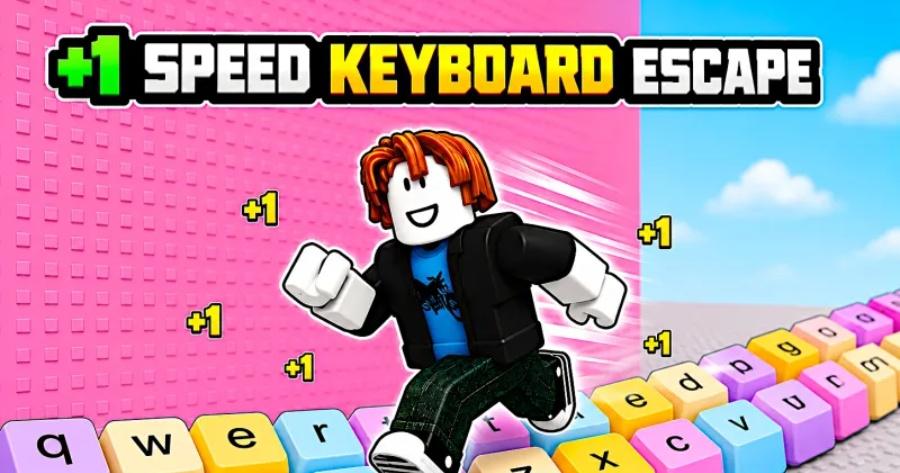
Spot the subtle key routes tucked quietly inside your escape run.
⌨️ Want to know where the cleanest escapes are hiding? Or just want to handle everyday runs like a tight hallway turn and a quick door dash without wiping out? A quick in-game test may reveal tricks you never knew your hands could pull off.
Explore the useful insights that could match your play style:
| Are You Using The Right Movement Timing? | How Fast Are Your Key Switches Really? |
| What Do Patterns Say About Safe Routes? | Share Your Trick With Friends |
Let's get something out of the way right now. If you've ever watched a top-tier Speed Keyboard Escape player on a replay and thought "that doesn't even look like the same game I'm playing," you weren't imagining things. It genuinely isn't. The game those players are running operates on a completely different set of rules than what you and I experience during a normal round, and the difference comes down to something that sounds impossibly technical but is actually more learnable than you'd think: frame-perfect sequence breaks.
That term probably sounds intimidating. Frame-perfect. Like something reserved for fighting game professionals or Tool-Assisted Speedrun videos on YouTube that might as well be CGI. But here's the thing, and this is what took me a while to really internalize, the execution window in Speed Keyboard Escape isn't nearly as brutal as the name implies. It's tight, absolutely. You're working within a single game tick, which is roughly a sixty-fourth of a second. But the human hand is capable of more precision than most of us give it credit for, and once you understand what you're actually trying to do, the "impossible" starts feeling more like "difficult but doable." There's a world of difference between those two things.
I spent about three weeks going down this rabbit hole. Failing constantly, getting maybe one clean break out of every thirty attempts at first, then one out of fifteen, then one out of five. And somewhere around the second week, when I chained two consecutive skips for the first time and watched my avatar slide past an entire obstacle section like it wasn't there, I understood why competitive players treat this stuff like gospel. The time savings are absurd. The feeling of pulling it off is even better.
What Sequence Breaking Actually Means And Why It Matters
Before we get into the how, let's make sure we're on the same page about the what. A sequence break, in the broadest sense, is any technique that lets you skip or bypass a section of a course that the developers designed you to play through normally. In Speed Keyboard Escape specifically, these breaks exploit subtle quirks in the game's physics engine, tiny gaps in collision detection, moments where the tick rate creates a window of opportunity that wasn't intentionally placed there but exists nonetheless.
Think of it like finding a shortcut through a hedge maze because two bushes don't quite touch at the roots. The maze designer didn't plan for you to squeeze through that gap. But the gap is there, and if you're observant enough to notice it and precise enough to fit through it, you've just saved yourself three turns and a dead end. That's sequence breaking in a nutshell.
Now, why should you care? Beyond the obvious thrill of doing something the game didn't expect you to do, the practical benefits are significant. Your completion times drop dramatically. We're not talking about shaving a fraction of a second here and there like you'd get from optimizing your basic movement. A clean sequence break can cut entire obstacle sections out of your run, saving multiple seconds per skip. Chain two or three of those together across a full course and you're posting times that players using standard routes physically cannot match no matter how fast their fingers are.
On the competitive side, this is where the leaderboard separates into tiers. The top runners aren't just faster at pressing keys. They're playing a shorter version of the course because they've identified and mastered breaks that eliminate the hardest sections entirely. If you've been stuck in the middle of the pack despite having solid basic mechanics, this is almost certainly the ceiling you've been hitting. Your fundamentals might be fine. Your route is what's holding you back.
There's also something less tangible but equally real. Practicing sequence breaks forces you to understand the game at a level that most players never reach. You start noticing how collision boundaries actually work, where hitboxes have soft edges, how the physics engine behaves differently depending on your avatar's velocity and angle of approach. That deeper understanding bleeds into every other aspect of your play. You read courses differently. You spot opportunities that used to be invisible. The whole game opens up in a way that's hard to describe until you've experienced it.
Getting Your Setup Right Before You Touch A Single Course
Here's something that most guides skip over entirely, and I think it's a mistake because it cost me probably a full week of wasted practice. Your hardware and software settings matter enormously when you're working with timing windows this tight. A sixty-fourth of a second is not forgiving, and if your inputs are fighting against lag that you don't even know exists, you're going to struggle with consistency in ways that feel random but aren't.
Start with your keyboard. If you're on a membrane keyboard, you're not necessarily out of luck, but you are working harder than you need to. Mechanical keyboards with low actuation points give you a faster physical response between the moment your finger commits to a press and the moment the input actually registers. That gap matters here. It matters a lot. You don't need to spend a fortune, but if you've been meaning to upgrade, this is as good a reason as any.
Beyond the keyboard itself, check your key repeat delay settings in your operating system. You want to make sure rapid taps aren't registering as held inputs, because accidental double registrations will destroy your timing on sequence breaks. Calibrate this until single taps feel crisp and intentional.
Close background applications. Seriously. That Discord overlay, the browser with forty-seven tabs, the Spotify client, whatever else is running in the tray. Each of those is potentially stealing system resources in micro-bursts that introduce tiny, unpredictable input delays. For normal gameplay it doesn't matter. For frame-perfect inputs it can be the difference between a clean break and a wasted attempt. I learned this the hard way after spending an entire evening convinced my timing was off when the real problem was a Windows update downloading in the background.
If you have a higher refresh rate monitor, use it. The visual feedback you get at 144Hz versus 60Hz makes it significantly easier to read the exact moment your avatar interacts with a collision boundary. You're essentially seeing more frames of information, which gives your brain more data to work with when it's trying to time that critical key press. It's not mandatory, but it helps. Everything in this section is about removing friction between your intention and your execution, and every bit of friction you eliminate makes the actual technique easier to learn.
Learning To Read The Physics
This is the step that separates people who eventually master sequence breaks from people who try for a few days and give up. You have to understand what you're looking at. And I mean really understand it, not just memorize a spot on the screen where you're supposed to press a key.
Every obstacle in Speed Keyboard Escape has a collision boundary, an invisible shape that defines where your avatar can and can't go. In a perfect game engine, these boundaries would be airtight. No gaps, no overlaps, no inconsistencies. But game engines aren't perfect, and the collision detection in this game has subtle weak points where boundaries either don't quite align or where the physics calculations create a frame or two of ambiguity about whether your avatar is "inside" the obstacle or "outside" of it. That ambiguity is your window.
The best way to find these weak points is to record yourself. Not your successful runs, your failed ones. Screen capture your attempts and then watch them back frame by frame. What you're looking for is moments where your avatar's position relative to the obstacle looks slightly different than you expected. A frame where you seem to clip into the edge of a platform before the game pushes you back. A moment where your vertical position stutters as you pass through a checkpoint trigger. These visual anomalies are breadcrumbs. They tell you where the collision boundaries have soft edges, and soft edges are where breaks live.
I know this sounds tedious. It is tedious. But it's also the difference between understanding a technique and just copying someone else's inputs and hoping for the best. When you understand why a break works at a specific spot, you can adapt your timing when server conditions change, when you approach from a slightly different angle, when an update subtly shifts obstacle placement. You're not locked into a memorized pattern that breaks the moment anything changes. You have the knowledge to adjust.
The First Frame-Perfect Input
Alright, let's talk about actually doing the thing. Your first frame-perfect input is going to feel like trying to thread a needle while riding a bike. That's normal. The coordination between what your eyes are reading, what your brain is processing, and what your fingers are doing is genuinely complex, and it takes time for those three systems to sync up.
The basic mechanic is this: you need to press your movement key at the exact moment your avatar contacts an invisible trigger zone on the obstacle. Not a fraction before. Not a fraction after. At contact. The physics engine processes your input and the collision event in the same tick, and when that happens, the game's logic gets confused about whether to apply the collision response or your movement input first. In most cases, your movement wins, and your avatar slides through or past the obstacle instead of being stopped by it.
Start slow. Pick one obstacle on one course that you've identified as having a soft collision boundary, this is where your replay analysis pays off, and just practice hitting that timing over and over. Don't worry about your run. Don't worry about your time. Don't worry about anything except landing that single input at the right moment.
Your first few dozen attempts will probably feel like complete guesswork. You'll press too early, too late, with too much hesitation, with too much force. That's fine. What you're actually doing during those failed attempts is building a proprioceptive map, teaching your nervous system what the correct timing feels like. Each failure narrows the window your brain is searching in. You won't notice the learning happening until suddenly, maybe on attempt forty or attempt sixty, it clicks. Your avatar slides through and you'll know in your fingers exactly what you did differently even if you can't articulate it in words.
That feeling is the foundation. Once you have it once, you can find it again. The consistency comes with repetition, but the initial breakthrough is the hard part.
Chaining Breaks Together
Single breaks are impressive. Chained breaks are where the real competitive advantage lives. And this is also, frankly, where things get significantly harder, because now you're not just executing one precise input in isolation. You're maintaining a rhythm of precise inputs across multiple obstacles while your avatar is in continuous motion and the visual landscape is changing rapidly around you.
The key insight here, and this took me longer than I'd like to admit to figure out, is that chaining isn't about raw speed. It's about rhythm. The game's internal tick rate is constant, and your inputs need to match that cadence. Think of it less like playing whack-a-mole and more like playing a musical instrument where the beat never changes but the notes move around. Your tempo stays locked in. Your fingers adjust position.
Practice chaining by connecting just two breaks first. Master the timing of the second break as a follow-up to the first, not as a standalone input. The transition between them, the exact rhythm of release-reposition-press, is its own micro-skill that needs separate practice. Once two feel reliable, add a third. Then a fourth. Build the chain one link at a time instead of trying to execute the whole sequence from the start.
You'll also need to adjust your finger pressure between breaks. This sounds like a small detail but it matters more than you'd expect. Different platform heights in the course change the physics interaction slightly, which means the optimal force of your key press varies from break to break. Heavy-handed tapping that works perfectly on a ground-level skip might register too aggressively on an elevated platform and miss the timing window entirely. Develop a lighter touch and you'll find your consistency improves across the board.
Why Your Breaks Will Stop Working And What To Do About It
Let me be upfront about something that every sequence break guide should mention but most don't. Your carefully practiced routes will break. Not might break. Will break. It's a question of when, not if.
Game developers patch their physics engines. Sometimes intentionally to close exploits, sometimes incidentally as a side effect of other updates. An obstacle whose collision boundary had a soft edge last week might be airtight after Tuesday's maintenance. A timing window that was tight but doable might shrink to genuinely impossible or disappear entirely. This is the nature of sequence breaking in a live service game, and if the idea of losing a technique you spent hours mastering sounds demoralizing, I won't pretend it isn't. It stings every time.
But here's the counterpoint, and this is why the "learn to read the physics" step earlier matters so much. When one break gets patched, new ones often appear. Physics changes that close one gap frequently open another somewhere else in the course. Players who understand the underlying mechanics can identify new opportunities quickly because they know what to look for. Players who only memorized a specific input sequence at a specific spot are stuck starting from scratch.
Stay current with update logs. Test your routes after every patch. And keep exploring. The game's physics landscape shifts over time, and the players who adapt fastest are the ones who stay at the top.
Server variance is the other consistency killer. Network latency between you and the game server can shift the effective timing of your inputs by a frame or two in either direction, and what works flawlessly on a low-latency connection might misfire on a high-latency one. If you notice your consistency dropping when you play at different times of day or on different network conditions, this is almost certainly the culprit. The fix is straightforward but time-consuming: practice your breaks across different server conditions until you develop a feel for how to adjust your timing based on the connection quality you're experiencing. It's an additional layer of skill, but it's the layer that separates reliable execution from situational luck.
The Honest Assessment
Here's the part where I level with you. Frame-perfect sequence breaking in Speed Keyboard Escape is not for everyone, and that's a perfectly fine thing to acknowledge. The practice commitment is real. The frustration during the learning phase is real. The possibility of patches invalidating your work is real. If you're playing this game casually for fun and the idea of spending multiple focused practice sessions on a single timing window sounds like the opposite of fun, then this isn't the path for you and there's nothing wrong with that.
But if something in you responds to the idea of pushing past what the game expects, of finding the cracks in the system and exploiting them, of posting times that make other players wonder if you're cheating when you're actually just better prepared, then this is the most rewarding rabbit hole Speed Keyboard Escape has to offer. The initial investment is steep. What you get back, both in competitive results and in a fundamentally deeper understanding of how the game actually works, is worth every failed attempt along the way.
Start with your setup. Record your first runs. Find one soft collision boundary. Practice until that first break clicks. Everything after that is refinement. And once you feel that avatar slide through an obstacle that's been stopping you for weeks, you'll understand exactly why people put in the hours. It's one of those moments that changes how you see the entire game.