







Popular Reviews



You've been playing Kitten Run: Anime for about seven minutes. You've completed three levels. In those seven minutes, you've watched an ad when the game loaded, an ad after completing level one, an ad in the middle of level two triggered by an obstacle collision, an ad after level two ended, an ad to receive your card reward, and now an ad has appeared before level four begins. Six ads in seven minutes. You start level four with the specific feeling of playing a game that exists primarily to deliver ads, with runner-and-card gameplay serving as connective tissue between ad-serving moments.
This isn't editorializing. This is what user reviews of Kitten Run: Anime consistently report. One recent review calls out "load four ads per level, no joke, you can also hit an ad obstacle in the level," and describes the game as forcing four-ad-per-level plus optional-ad-obstacles for extra rewards. Another says "the gameplay consists of skipping ads rather than collecting cards." A third points out that when ads fail to load, "the game crashes with absolutely zero way to skip the crashed ad."
That's Kitten Run: Anime, and this review is going to walk through what the game claims to be, what it actually is when you play it, and who the specific audience for this particular kind of experience actually is.
What The Game Claims To Be
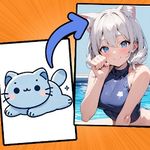
According to its Play Store description, Kitten Run: Anime is a casual runner where you control a cat character dodging obstacles, collecting cards through gates, and unlocking "beautiful anime cat-girl transformations." Developed by Korean solo developer iree (hongsoft) and released on Google Play with a 4.3-star average across roughly 13,000 reviews (1M+ downloads), it markets itself as a light, collection-focused runner appealing to anime-adjacent casual gamers.
Core mechanical elements as described:
-
Runner gameplay with dodging and lane-switching
-
Gates system for choosing card upgrades mid-run
-
Card collection that unlocks illustrated anime cat-girl characters
-
Upgrade progression through repeated runs
-
Illustration gallery for viewing collected characters
What The Game Actually Is When You Play It
The runner-and-card DNA is legitimate but wrapped in one of the more aggressive ad implementations currently on the Play Store, and the "cat-girl illustrations" that serve as your collection reward appear (per detailed user reviews) to be AI-generated rather than commissioned art.
The specific pattern that emerges from reading user reviews:
Ad frequency far exceeds industry norms. Users report interstitial ads between every level, additional ads for reward collection, rewarded-ad obstacles placed within levels, and ads appearing at unexpected interaction points. This is not standard free-to-play behavior — it's specifically dense.
AI-generated art on the cards. One user calls the reward illustrations "poorly generated image of an anime girl, with the high chance of them having cat ears." Given the specific cadence of card additions and the visual consistency issues typical of AI generation, this appears accurate.
Progression breaks at specific points. Users report the game becoming unplayable around level 53 with no fix acknowledged in developer responses.
Card trading mini-game exists. Beyond direct collection, there's a secondary layer where you can trade cards with the game to receive different cards — but this too is ad-gated.
The result is a game where the actual runner-and-collection gameplay works fine when you can access it, but the ad frequency creates a specific texture where playing feels less like enjoying a game and more like processing through an ad-delivery system.
The Runner Gameplay, When You Get To It
Underneath the ad density, the runner itself is competent hyper-casual.
Your cat character auto-runs forward through 3D lanes. You swipe or tap to change lanes, dodge obstacles, and pass through numbered gates that provide upgrades. Gates come in choice pairs — a "+2 cards" gate versus a "×3 damage" gate, requiring you to choose which side to enter. Wrong choices produce weaker runs; correct choices at the right moments produce stronger card acquisitions.
Obstacles include the standard hyper-casual roster — moving barriers, spike patches, jumping obstacles, moving enemies. Runs typically last 60-90 seconds if you don't die early.
At the end of each run, you collect the cards you accumulated, which unlock or upgrade specific cat-girl characters in your collection. Collection progress serves as the meta-progression that gives runs their long-term purpose.
None of this is bad design. In a game with reasonable ad density, this would be perfectly acceptable hyper-casual. The problem is the ad density, not the gameplay.
The Art Concern
The claim that the character illustrations are AI-generated deserves examination.
AI-generated character art in casual games has become common over the past two years as tools like Stable Diffusion have made character generation cheap and fast. For small developers, generating hundreds of character variants is now possible without commissioning artists. This has trade-offs:
Cost efficiency enables solo developers to compete with larger studios. Volume means more content faster. Consistency issues appear — characters often have subtle anatomical inconsistencies, extra fingers, uncanny eye positioning, or specific "AI artifacts" that human artists don't produce. Ethical concerns around AI training data affect how some players perceive the content. Commodification happens — the specific illustrations feel generic in ways that hand-drawn character art doesn't.
Kitten Run's card art, based on user reports, exhibits these AI patterns. For players who don't care about art provenance, this may not matter. For players who specifically value handcrafted illustration, this is a real limitation.
The Monetization Structure
Kitten Run: Anime uses standard hyper-casual monetization:
Ad density is the primary revenue mechanism — the game maximizes ad views per user session. Rewarded ads provide optional bonuses for watching additional ads on top of forced interstitials. In-app purchases (limited from what user reviews indicate) may offer ad removal or premium content.
The specific pattern makes commercial sense for the developer — hyper-casual games monetize almost entirely through ad revenue, and higher ad density directly increases developer income. The trade-off, obviously, is user experience degradation. Different games find different points on this trade-off curve. Kitten Run: Anime lands significantly further toward the ad-density side than most.
Who Should Play This
Playing Kitten Run: Anime makes sense if: you specifically want a very lightweight anime-adjacent runner with no expectation of premium quality; you're comfortable with heavy ad interruption; you enjoy card collection mechanics regardless of art source; you have unstable internet where you can't reliably watch ads (which paradoxically may reduce forced-ad interruptions).
Skipping this makes sense if: you're sensitive to ad-heavy free-to-play patterns; you specifically value hand-crafted rather than AI-generated art; you want gameplay that doesn't feel structured around ad delivery; you have limited patience for game instability at higher levels.
For the specific audience of casual mobile players comfortable with heavy ad monetization who specifically enjoy the runner+card+anime collection formula, Kitten Run: Anime provides its specific value at zero upfront cost. For most other players, the ad density will feel exploitative in ways that outweigh what the gameplay offers.